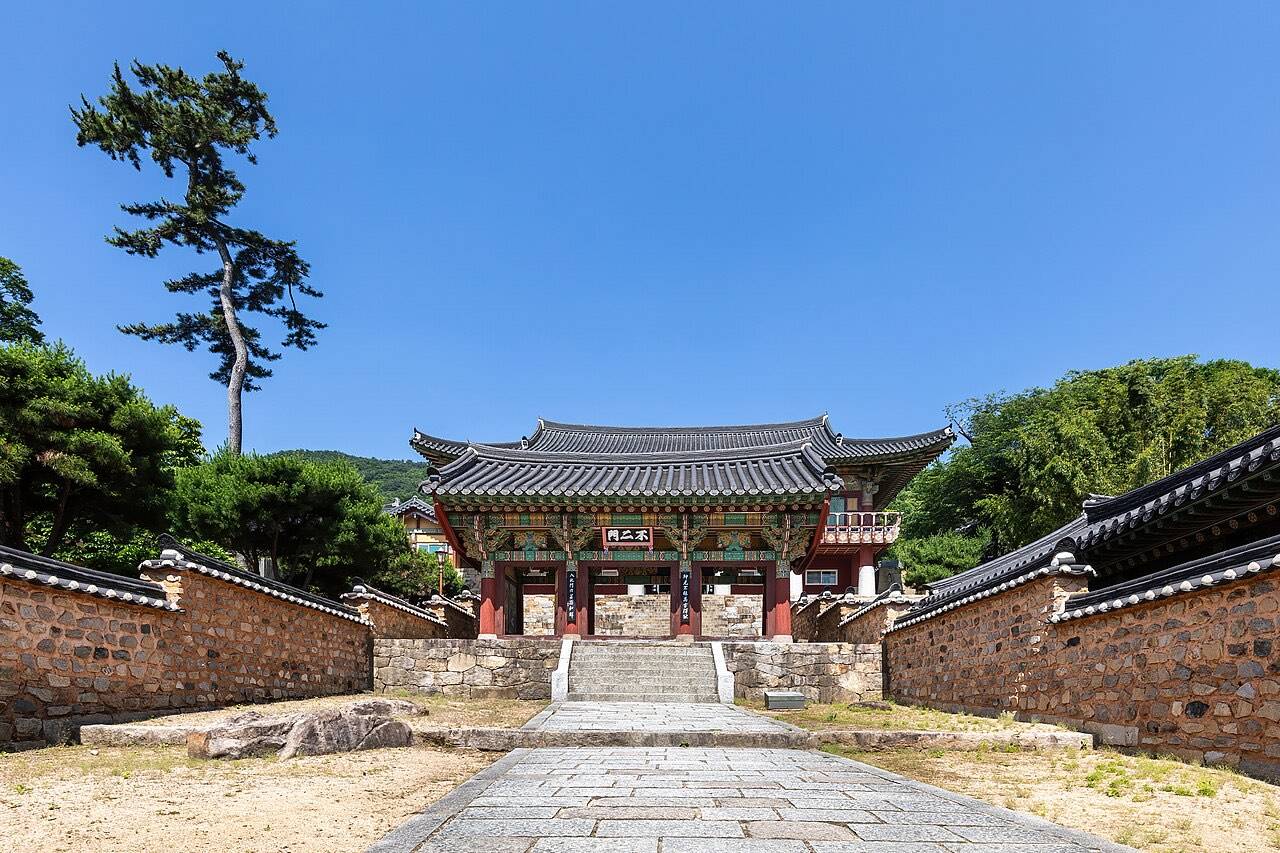
A templestay is an overnight stay inside a working Buddhist temple: you sleep in the guest quarters, eat the temple's food, and follow part of its daily rhythm. It's one of Korea's most rewarding experiences, it's set up specifically to welcome foreigners, and hardly anyone books it before they arrive. Ask a repeat visitor for their favorite memory of Korea and a lot of them land on this over the palaces and fried chicken.
Many of these temples are centuries old and sit deep in the mountains, in scenery you'd otherwise only glimpse from a bus window. This isn't a staged cultural show, either. The monks live there, the schedule is theirs, and you're a guest inside it for a night.
What a templestay actually is
The program is run nationwide by the Cultural Corps of Korean Buddhism, which coordinates dozens of participating temples through a single English booking site. Temples broadly offer two kinds of program:
- Experience-focused — you take part in monastic life: chanting, bowing, meditation, the formal meal. Choose this if you want to know what a temple day actually feels like.
- Relaxation / free — a lighter version with more downtime to walk the grounds, drink tea and rest. Choose this if you mainly want quiet and scenery.
Both include your room, meals and a set of temple clothes to wear during your stay. You don't need to be Buddhist or speak Korean, since the larger temples run sessions with English guidance.
What a night really looks like
Here's the honest version, because it's the part most people wish they'd known. You usually check in around 2 p.m. After changing into the temple uniform, there's an orientation and a tour, and you learn the basics: how to bow, how to enter the halls, how to behave during ceremonies.
Late afternoon or early evening brings yebul, the chanting service in the main hall, often followed by seated meditation or a quiet tea with a monk. Dinner is early and simple. Lights out is around 9 p.m., because the day starts long before dawn.
And it really does start early. Wake-up is typically between 3 and 5:30 a.m., called by the temple's rolling drum and bell. You join the pre-dawn chanting and, at many temples, the 108 prostrations, a slow sequence of bows that is far more physical than it sounds. Breakfast is the formal monastic meal, and after a morning walk or a final tea you check out mid-morning, usually around 10 a.m. It's roughly a 20-hour arc, and most people call it the calmest stretch of their whole trip.
The practices you'll try
- Yebul — the ceremonial chanting at dawn and evening, in the incense-filled main hall.
- Chamseon — seated Zen meditation, sometimes facing a wall.
- 108 prostrations — one bow for each of the 108 earthly desires. A moving, sweat-inducing meditation.
- Barugongyang — the formal monastic meal eaten from a set of nested bowls, where you take only what you'll finish and clean the bowls with water and a slice of radish so nothing is wasted.
- Tea with a monk — often the highlight. An unhurried conversation over traditional tea, and your chance to ask anything.
At Golgulsa, near Gyeongju, you can also try Seonmudo, a flowing Buddhist martial art that blends meditation with movement and is one of the temple's signatures.
What it costs, and what's included
Templestays are among the best-value experiences in Korea. Most programs run roughly ₩70,000–150,000 per person per night (about US$50–110), including your room, all meals and the temple clothing. For a bed, three meals and a real cultural immersion in a mountain setting, that's hard to beat, and it's a fraction of what a comparable wellness retreat would charge elsewhere.
Who it suits (and who it doesn't)
Come if you want a real cultural experience, a proper digital detox, or a calm night between two busy cities. Skip it if you need Western comforts, a lie-in, or a drink with dinner. Rooms are simple, you sleep on a padded mat on a heated ondol floor rather than a bed, temples are alcohol- and meat-light, and the early start is non-negotiable. The simplicity is deliberate, and it helps to arrive expecting it.
A templestay is not a hotel stay. You're borrowing a monk's routine for a day, so pack for simplicity rather than comfort.
Best temples to choose
There are dozens of options. These are reliable, foreigner-friendly starting points, especially for a trip beyond Seoul. Always confirm current programs and available languages on the official site before you book.
- Beomeosa (Busan) — a major mountain temple reachable on the city subway and a short bus, so you can do a templestay without leaving your Busan itinerary.
- Golgulsa (near Gyeongju) — famous for Seonmudo martial-art training and for being Korea's only stone-cave temple, with a Buddha carved into the cliff.
- Haeinsa (near Daegu) — home of the Tripitaka Koreana, the vast set of 13th-century woodblocks that is a UNESCO treasure.
- Magoksa (Gongju) and Beopjusa (Songnisan) — serene, UNESCO-listed mountain temples if you're routing through the center of the country.
- Naksansa (Yangyang) — a rare seaside temple on the east coast, near Sokcho and Gangneung.
How to book
The official English booking portal is eng.templestay.com, run by the Cultural Corps of Korean Buddhism. You can filter temples by region and by program type (experience vs. relaxation), see what activities each offers, and book directly. Reserve well ahead for weekends and autumn-foliage season, when the best temples fill up fast.
Fitting it into a trip beyond Seoul
A templestay slots neatly into a southern route. If you're doing Busan and Gyeongju anyway, Beomeosa and Golgulsa are both right there, so you can spend a night in the mountains without backtracking. Arrive by KTX, see the city by day, and head up for the evening program. Raw-fish markets and neon one night, drums and silence the next: that contrast is what sticks.
What to pack, and a few etiquette notes
- Modest, comfortable clothes for arrival (shoulders and knees covered); you'll change into temple clothing on site.
- Slip-on shoes, since you'll remove them constantly.
- A light layer, because mountain temples get cold at dawn, even in summer.
- Keep your voice low, follow your guide's lead in the halls, and switch your phone to silent. Photos are usually fine outdoors but not during ceremonies.
If you add one lesser-known experience to your Korea trip, make it this one. Most people come down the mountain calmer than they went up.